Blog
An invasion begins….
Author: Mike Clough
Date Posted: Wednesday 13th May 2026

0161 723 2000
8AM to 5PM
Author: Mike Clough
Date Posted: Wednesday 13th May 2026
People often say to me, ‘How do these invasive species get a foothold…why did nobody notice?’
Well, with Japanese knotweed …the truth is, somebody did notice. The Environment Agency officers around the UK flagged up the spreading problem of Japanese knotweed and they were ignored.
Rumor has it, that it was all budgetary related.
Field officers flagged up the issue but there were no funds available. Flooding was seen as the major issue – not some plant that was quickly spreading – so the issues were ignored. The field officers were ignored and the Knotweed continued to spread.
It has been said that when first identified, the issues with the plant could have been dealt with and eradicated effectively.
Having been ignored, the exponential growth meant that not only could Japanese knotweed not be eradicated – it could not even be contained.
It could be argued that we are now more aware and that these type of scenarios just wouldn’t happen.
Take a little trip over to the United States.
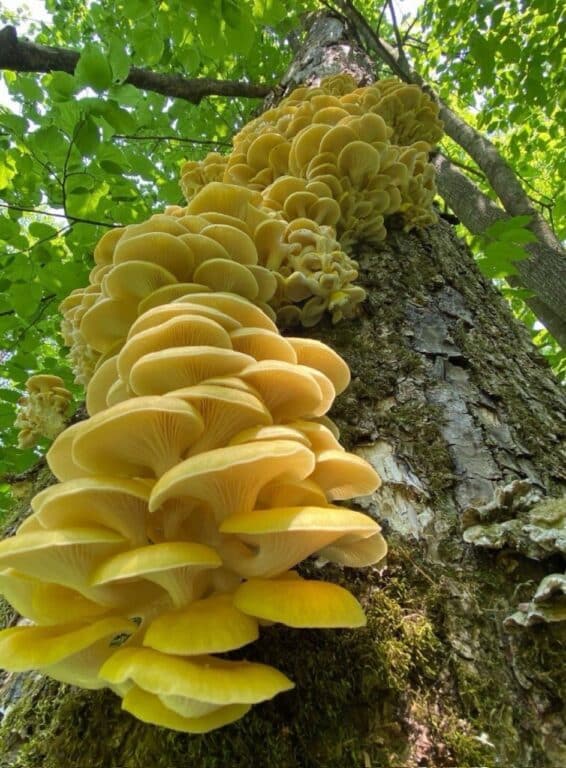
The golden oyster mushroom (Pleurotus citrinopileatus) began its life in the forests of Northern China and Japan, where it has been a staple of local cuisine for centuries.
They were introduced to the US in the early 2000’s as the culinary market began to bloom.
Home-grown mushroom kits were easily accessible – the kits were cheap and wildly popular and somewhere along the line ….the mushroom got out.
Mushroom farms release millions of spores every minute.
Consumers may have done the rest.
Either way, it was out there.
This has resulted in a massive loss of diversity in the forests.
Why does this matter?
Fungi are not incidental to forest life but are foundational to it. They break down dead wood, cycle nutrients back into soil and form symbiotic networks with other plant life.
Such loss of diversity will impact humans too, fungi are a common source of medicines, including penicillin….
These plants are pushing out native biodiversity and potentially causing local extinctions, meaning a loss of what could be a plant that could have lifesaving properties that will be lost forever.
Mike C